

Important framing:
The following summarizes claims, allegations, and statements reported in documents, not established conclusions. Where possible, document IDs are cited. No criminal guilt is asserted.
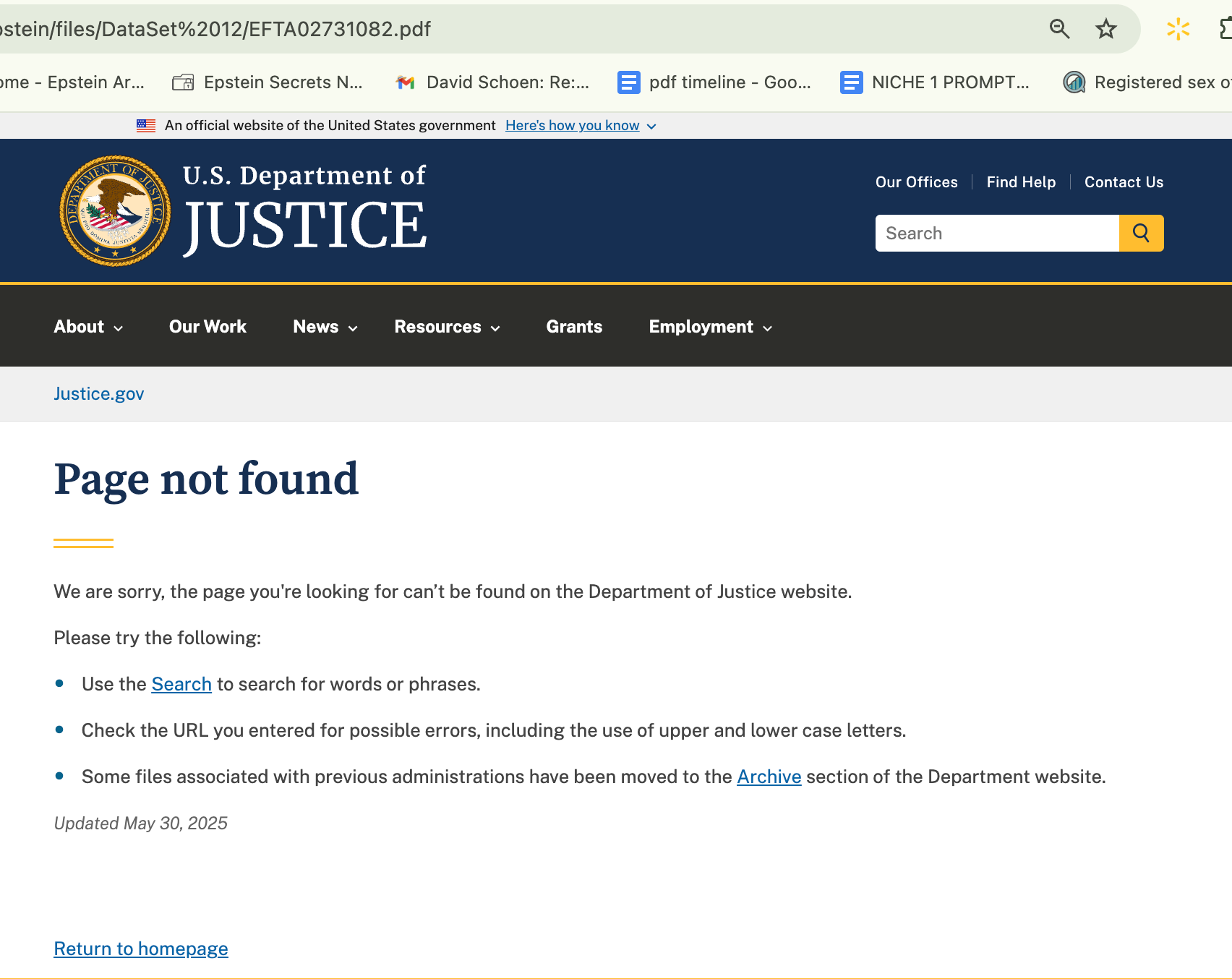
Yesterday, February 7, 2026, the Miami Herald reported on the existence of an 86-page memo detailing potential co-conspirators connected to Jeffrey Epstein — a memo that was quietly deleted from the Department of Justice website.
According to the reporting, this document was not a rumor, not a leak, and not speculative commentary. It was a formal DOJ memo. Eighty-six pages long. And it named individuals who investigators believed may have been involved in, facilitated, or materially benefited from Epstein’s trafficking operation.
The memo is no longer accessible through official DOJ channels. Document ID: EFTA02731082.pdf
This matters — not because documents occasionally move or get archived, but because the Epstein case is not a closed chapter. It is an open wound. Survivors are still alive. Evidence is still being litigated. Names continue to surface. And public trust has already been eroded by years of sealed records, non-prosecution agreements, and selective transparency.
An 86-page memo doesn’t vanish by accident.

Who Was Listed
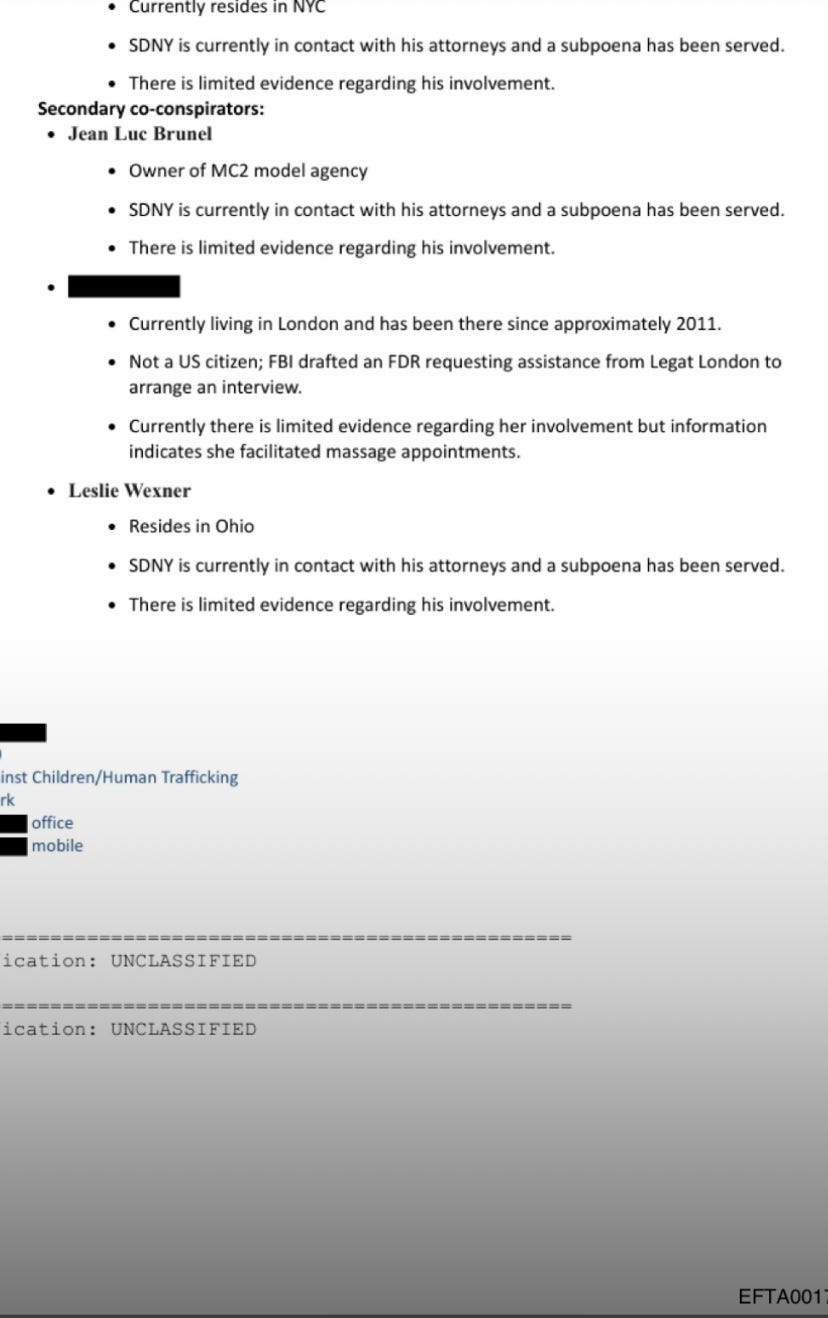
Secondary Co-Conspirators (as listed in the memo).
Jean-Luc Brunel
Owner of the MC2 modeling agency.
The Southern District of New York (SDNY) was in contact with his attorneys, and a subpoena had been served.
The memo states there was limited evidence regarding his involvement.
Unnamed Individual (Redacted Female)
The memo states there was limited evidence regarding her involvement.
Information indicated she facilitated massage appointments.
Resided in London since approximately 2011.
Not a U.S. citizen.
The FBI drafted an FDR requesting assistance from the Legal Attaché (Legat) in London to arrange an interview.
Leslie Wexner
Resided in Ohio.
SDNY was in contact with his attorneys, and a subpoena had been served.
The memo states there was limited evidence regarding his involvement.
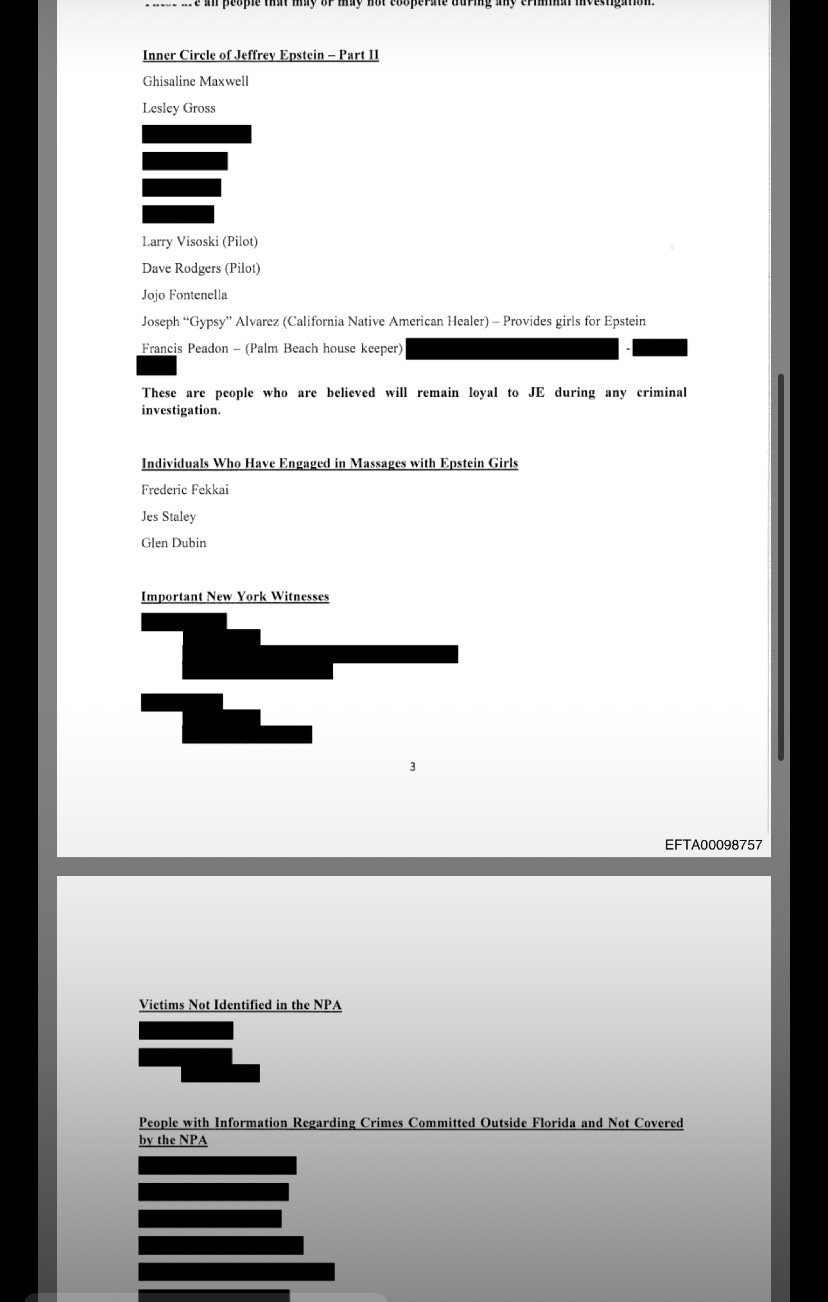
You can find a subsection of this memo also listed in document # EFTA00098755.pdf (6 pages still available as of 2/8/26)
Jean Luc Brunel - Potential Co-Conspirator
Jean-Luc Brunel was a French modeling agent and the founder of MC2 Model Management, an agency that operated in Paris, Miami, and New York. His name has been publicly linked to Jeffrey Epstein for years, long before the most recent DOJ memo surfaced.
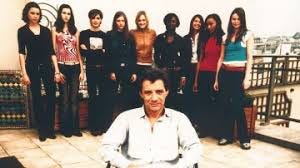
Multiple victims have alleged that Epstein used modeling as a pipeline to recruit young women and girls, and Brunel’s agency has repeatedly appeared in those accounts. Survivors have stated that Epstein and Brunel socialized frequently, traveled in overlapping circles, and shared access to models and aspiring models—many of whom were teenagers at the time.
In 2019, it was revealed that Brunel was among those named in court documents from a civil suit by Virginia Giuffre against Ghislaine Maxwell. The documents were unsealed on 9 August 2019, a day before Epstein’s death. Giuffre alleged that she was sexually trafficked by Epstein and Maxwell to several high-profile individuals, including Brunel and Prince Andrew, while she was underage in the early 2000s.

Document ID: EFTA02505789.pdf
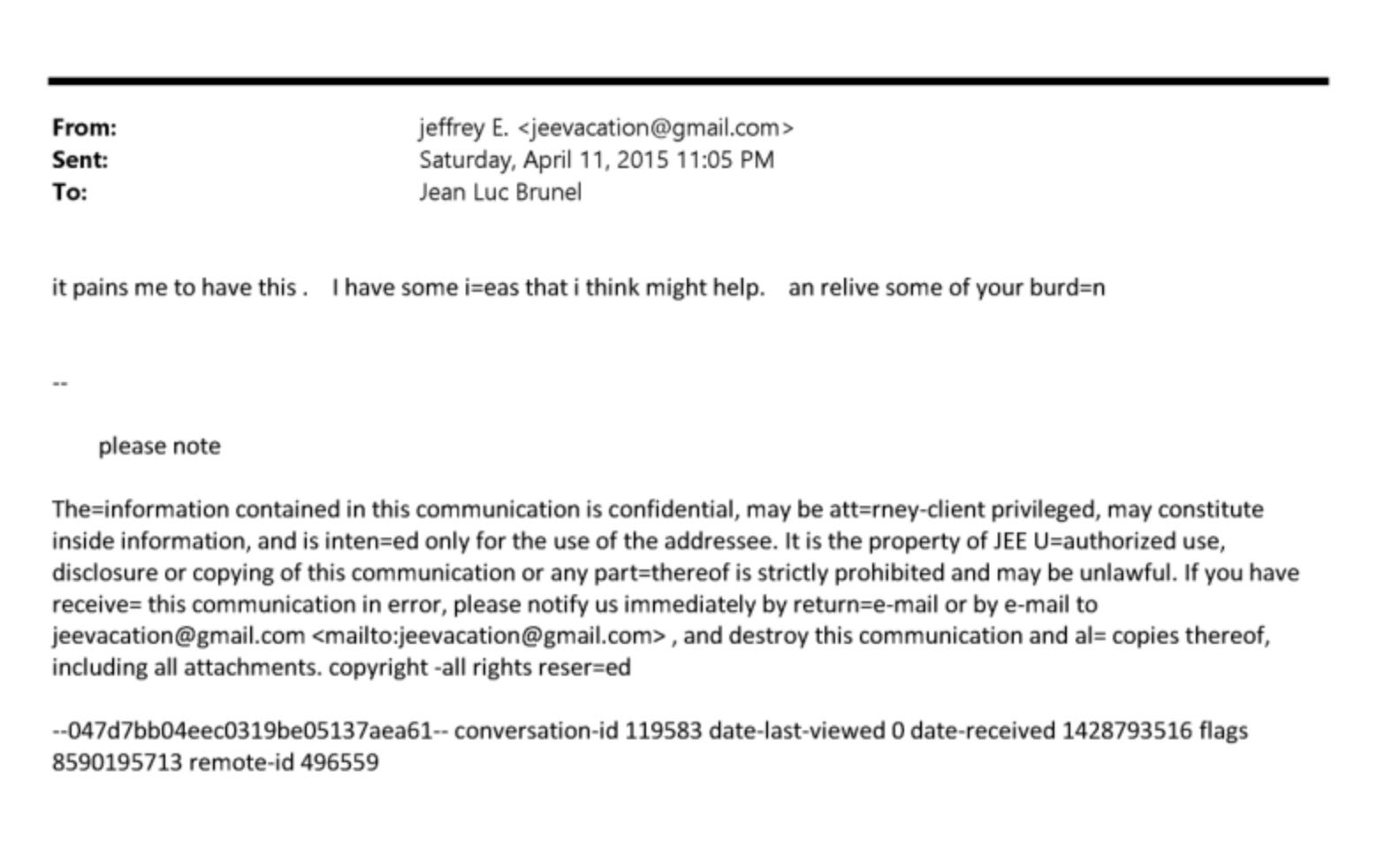
Court filings, civil lawsuits, and witness statements have described Brunel as a close associate of Epstein. Several women alleged that Brunel introduced them to Epstein, pressured them into sexual encounters, or facilitated situations where exploitation occurred. These allegations span decades and multiple jurisdictions.
Document ID: EFTA02731361.pdf
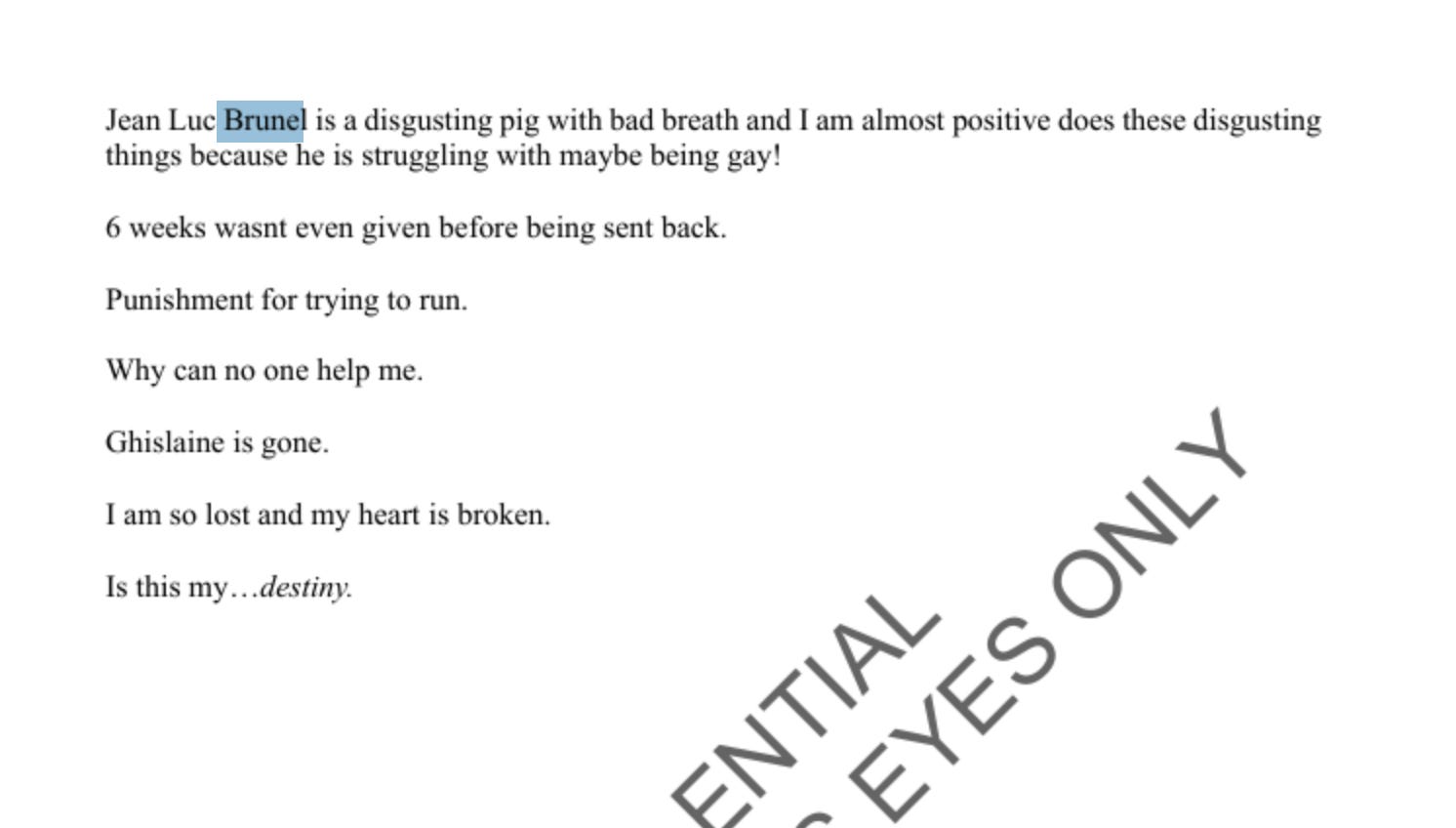
The document above is a journal (EFTA02731361.pdf) kept by an alleged teenage victim of Jeffrey Epstein that references Jean-Luc Brunel. In it, she describes in explicit detail repeated forced pregnancies. Here is a video and article expanding on the journal:

Brunel denied wrongdoing throughout his life. However, his proximity to Epstein was not limited to casual acquaintance. Epstein was reported to have financially supported MC2 at various points, and Brunel was photographed with Epstein on multiple occasions, including in social and professional settings tied to the modeling world.

Brunel was last seen in public at the Paris Country Club on 5 July 2019. In 2020, Brunel was arrested in France on charges related to the rape of minors and sexual assault. While those charges were separate from U.S. federal proceedings involving Epstein, they stemmed from similar patterns of alleged abuse described by victims—recruitment through modeling, exploitation of age and power imbalance, and the normalization of abuse within elite social networks.
In 2022, Jean-Luc Brunel was found dead in a French prison cell while awaiting trial. His death was ruled a suicide. Jeffrey Epstein was also found dead in his cell in 2019, his death was ruled a suicide.

Despite his death, Brunel continues to appear in investigative records related to Epstein, including the DOJ memo referenced by the Miami Herald. His inclusion underscores a broader reality of the Epstein case: many central figures were never fully prosecuted in U.S. courts, and key questions about facilitation, recruitment, and institutional failure remain unresolved.
The presence of Brunel’s name in an internal DOJ document—after Epstein’s death—suggests that federal investigators continued to view his role as significant enough to document, even if evidence was described as “limited” at the time.
Les Wexner - Potential Co-Conspirator
Leslie Wexner, the Ohio-based billionaire founder of L Brands (formerly Limited Brands), is one of the most well-documented financial associates of Jeffrey Epstein. For years, Epstein functioned as Wexner’s personal financial advisor and held sweeping authority over his finances—authority that was highly unusual even within elite wealth-management circles.
Wexner granted Epstein power of attorney in the early 1990s, allowing him broad control over assets, legal matters, and financial decisions. Epstein also lived rent-free for years in a Manhattan townhouse later identified by prosecutors as a central location in his trafficking operation. The property was owned by a Wexner-controlled entity and was eventually transferred to Epstein under circumstances that have never been fully explained.

After Epstein’s 2008 federal non-prosecution agreement became public, Wexner stated that he severed ties with Epstein and later said he was unaware of Epstein’s criminal behavior at the time of their association. No criminal charges have been filed against Wexner in connection with Epstein.
Nevertheless, Epstein’s role as Wexner’s money manager was foundational to Epstein’s rise. Multiple investigations and civil cases have noted that Wexner’s wealth, connections, and institutional credibility helped position Epstein within elite political, academic, and social circles long before his crimes were publicly exposed.
Wexner is also one of the largest benefactors in the history of The Ohio State University (OSU).

Over decades, he and the Wexner Foundation have donated hundreds of millions of dollars to the university, funding major facilities, academic programs, and the Wexner Medical Center. His name is embedded throughout the institution.

OSU’s name later became nationally associated with another large-scale sexual abuse scandal involving team doctor Richard Strauss, whose abuse of students spanned years and was later found to have been ignored or inadequately addressed by the university. While the Strauss scandal may be unrelated to Epstein, it has shaped public scrutiny around how powerful institutions respond to allegations of sexual abuse—and how donor influence and reputation management can complicate accountability.
In the DOJ memo referenced by the Miami Herald, Wexner is listed as a “secondary co-conspirator,” with the document noting that SDNY was in contact with his attorneys and that a subpoena had been served. The memo states that there was “limited evidence” regarding his involvement. The document does not allege criminal conduct or draw conclusions.
The significance of Wexner’s inclusion is not a declaration of guilt, but a reflection of investigative interest. His financial and personal relationship with Epstein was substantial, prolonged, and instrumental to Epstein’s access to wealth and power. That relationship alone has continued to raise unresolved questions—particularly as institutions tied to major donors often escape the level of scrutiny applied to individuals without comparable influence.
As with much of the Epstein case, the record remains incomplete. What is clear is that Epstein did not operate in isolation. He relied on proximity to money, legitimacy, and institutional respectability—and Leslie Wexner was central to that ecosystem.
Deleted 86 Page Memo
The existence of this document directly contradicts the long-standing narrative that Epstein “acted alone,” or that meaningful investigations ended with his death. If federal prosecutors were compiling a memo of this scope, it suggests the government itself believed there were additional actors worth scrutinizing — possibly criminally.
The deletion raises immediate questions:
Who authored the memo?
When was it finalized?
Why was it made public at all — and why was it removed?
And most importantly: who was named?
For journalists, researchers, and the public, this deletion reinforces a pattern that has defined the Epstein case from the beginning: information appears, briefly, and then is obscured. Files are released in fragments. Context is stripped away. Survivors are left to relive their trauma while institutions retreat behind bureaucracy.
Transparency should not be optional in a case involving systemic sexual exploitation of minors.
If the DOJ believes disclosure would compromise active investigations, that argument should be made openly. If names are redacted for legal reasons, that should be explained. But silent removal only fuels distrust — especially when the crimes in question involve powerful people, money, and decades of protection.
The Miami Herald’s reporting confirms what many have suspected for years: the full story has never been told, and efforts to document it continue to face resistance.


